






Learn how balancing rebar ductility and tensile strength improves seismic resilience and structural integrity in modern construction projects.
BS 4449 is the definitive British Standard that specifies the requirements for weldable, ribbed carbon steel bars, coils, and decoiled products used for the reinforcement of concrete. This standard classifies steel into three primary grades: B500A, B500B, and B500C.
All three grades share a mandatory characteristic yield strength of 500 MPa. However, they differ strictly in their ductility characteristics and performance under cyclic or seismic loading. The standard requires destructive testing of full-section rebar samples to map their stress-strain performance.
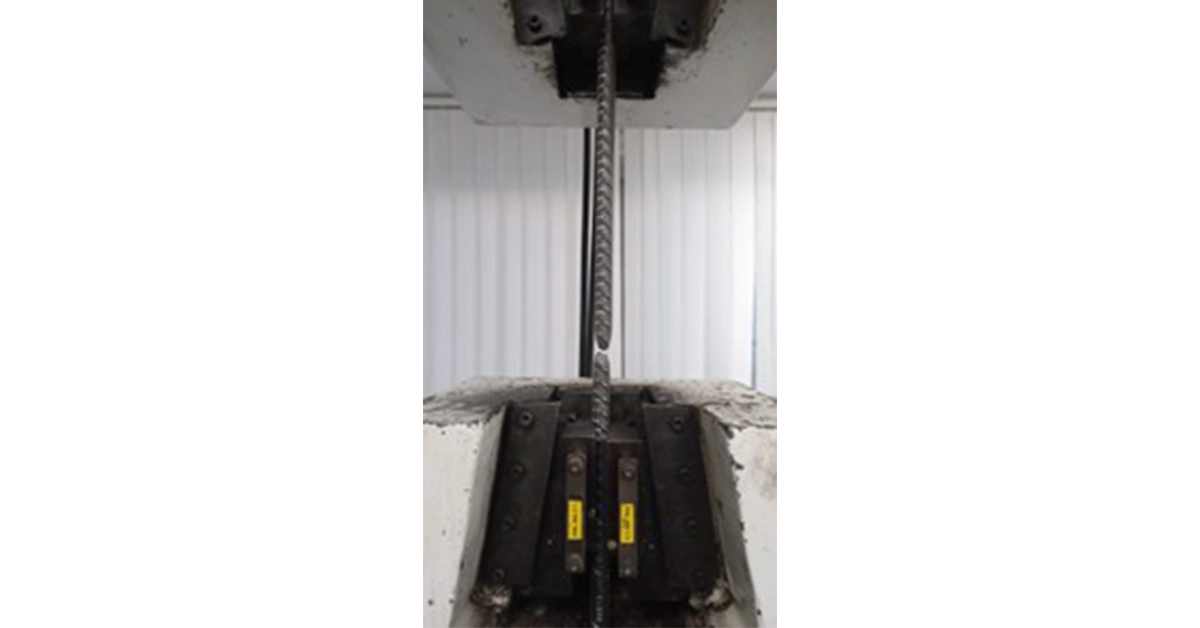
Tensile and Yield Strength Determination:
Universal Testing Machine (UTM) is used to find the yield strength and ultimate tensile strength using the nominal cross-sectional area. The maximum yield strength is capped at 650 MPa.
The Ductility Ratio (Tensile/Yield Strength ratio): The ratio of ultimate strength to yield strength is calculated as a statistical characteristic value.
Grade B500A: Low ductility with ductility ratio of 1.05
Grade B500B: Medium ductility with ductility ratio of 1.08
Grade B500C: High ductility with ductility ratio of 1.15 to 1.35
Total Elongation at Maximum Force:
This measures uniform plastic stretch before the bar begins localized necking. Under the standard, the target threshold limits are,
Grade B500A: ≥ 2.5%
Grade B500B: ≥ 5.0%
Grade B500C: ≥ 7.5%
The Bend Test:
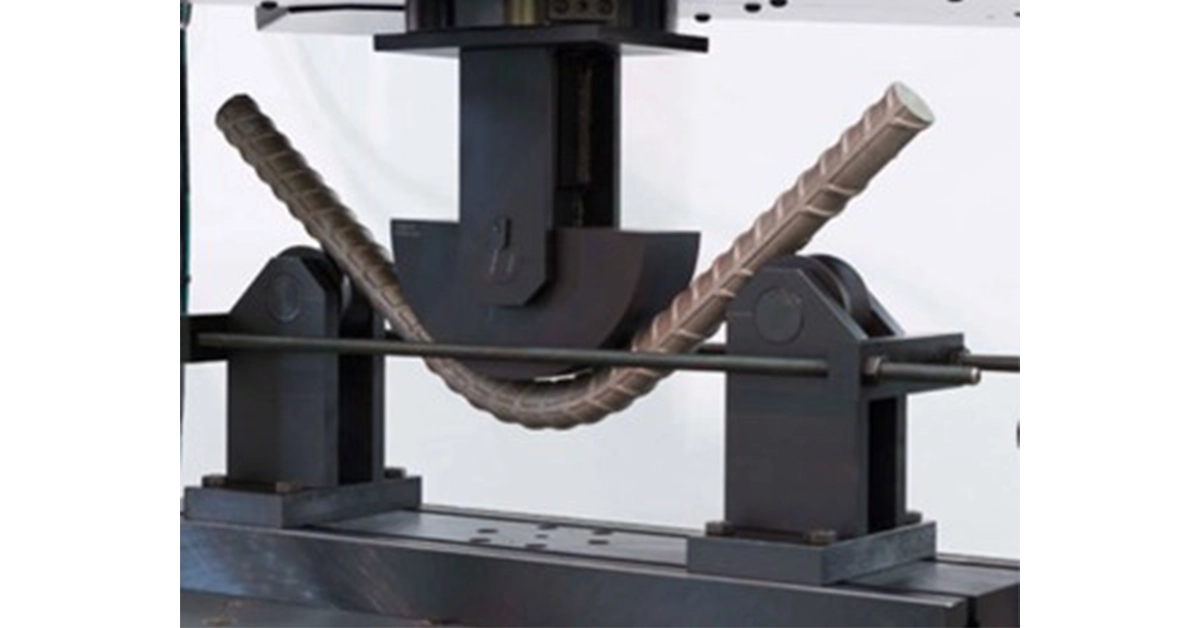
The bend test evaluates the general soundness and surface ductility of the steel when subjected to cold plastic deformation.
The straight steel specimen is bent over a specified standard mandrel using a smooth, continuous force. After bending the sample at an angle of 180°, the outer surface of the bent portion must show no signs of fracture, cracks, or irregular bending deformation when viewed by a trained technician.
The Re-bend Test:
The re-bend test is a separate, more rigorous process designed to measure the effect of strain aging—an embrittlement effect that occurs after cold work due to nitrogen diffusion in the steel.
The specimen is bend to an angle of 90° over the specified mandrel and heat aged at 100°C for at least 1 hour this accelerates any potential aging embrittlement. The sample is then cool naturally back down to room temperature and Reverse-bend (unbend) by at least 20°. the outer surface of the bent portion must show no signs of fracture, cracks, or irregular bending deformation when viewed by a trained technician.
The chemical composition test:
The chemical composition test for reinforcing steel under BS 4449 ensures the material retains mandatory weldability, structural ductility, and resistance to long-term strain aging. The standard enforces strict maximum thresholds for key chemical elements and sets limits based on cast analysis (at the steel melt shop) and product analysis (on the finished bar). Optical Emission Spectrometry (OES) is the primary laboratory method used. A small cross-section disc is cut from the rebar, polished, and placed inside a spectrometer. An electric arc sparks against the sample, and the wavelength of emitted light determines the exact percentage of every element.
BS 4449 regulates elements that directly impact metallurgical behavior. Below are the exact thresholds for standard grades.
|
Element |
Cast Analysis |
Product Analysis |
Primary Metallurgical Purpose |
|
Carbon (C) |
0.22% |
0.24% |
Controls base strength versus brittleness. |
|
Sulfur (S) |
0.05% |
0.055% |
Prevents "hot shortness" (cracking during hot rolling). |
|
Phosphorus (P) |
0.05% |
0.055% |
Prevents cold-shortness (embrittlement at low temperatures). |
|
Nitrogen (N) |
0.012% |
0.014% |
Critical control element for the rebend/strain-aging test. |
|
Copper (Cu) |
0.80% |
0.85% |
Controls scrap-metal contamination and corrosion. |
|
Carbon Equivalent (CEV) |
0.50% |
0.52% |
Main structural indicator for overall weldability. |
Steel tensile Test
Steel bend test
About Cotecna
For over 50 years, Cotecna has been supporting supply chains in the agriculture, food and pharma, minerals and metals, and consumer products sectors worldwide. We offer testing, inspection, and certification services to help our clients navigate evolving regulations, ensure product compliance, and advance their sustainability goals.